
Let’s address the elephant in the studio: artificial intelligence is dominating music industry headlines, and as an independent artist, you are rightfully protective of your craft. You’ve spent countless hours writing, arranging, and mixing your tracks. The last thing you want is an algorithm stepping in to replace your creative soul.
But there is a massive difference between an AI that creates and an AI that finishes.
AI mastering software isn’t here to write your hooks or dictate your arrangement. Instead, it acts as an automated, objective second set of ears to get your mix over the finish line. In this guide, we are breaking down what AI can actually do for your workflow, what its limitations are, and the best tools available in 2026 to give your tracks that final, professional polish.
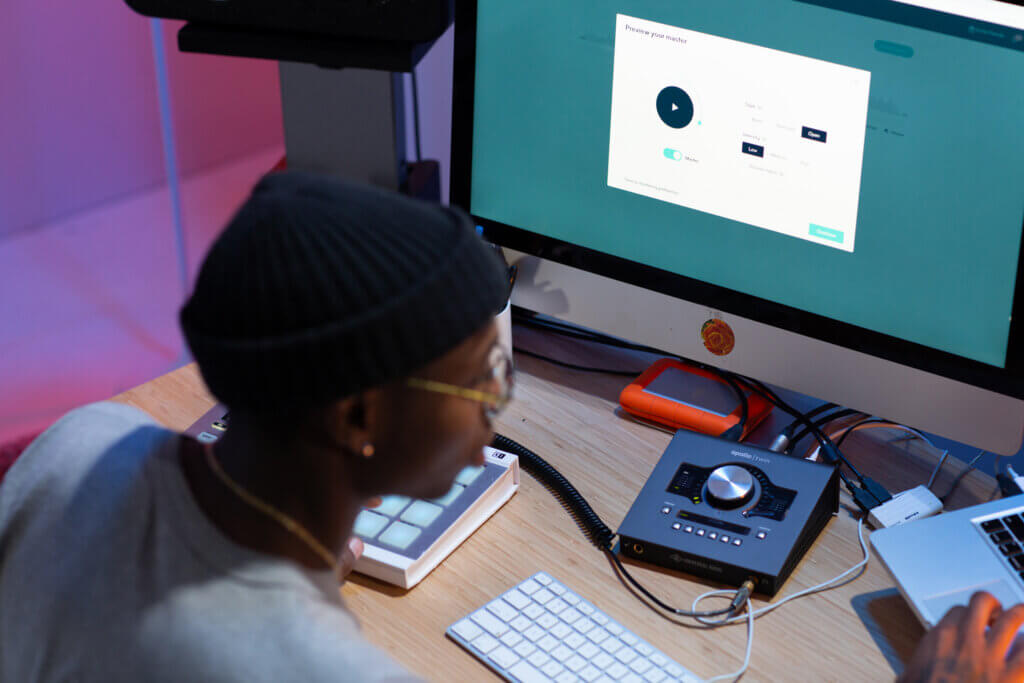
Generative AI vs. AI Mastering: Protecting Your Creativity
To understand why AI mastering tools are so valuable, we first need to separate the tool from the threat.
Generative AI is the technology creating headlines (and headaches). Generative AI creates music from scratch based on text prompts or inputs. It generates melodies, chords, and vocals.
AI Mastering is the technology that doesn’t generate a single note. Instead, it listens to the music you have already created. It analyzes your mix’s frequency balance, dynamics, and stereo spread, and then applies corrective EQ, compression, and limiting based on thousands of data points from professionally mastered hit records.
AI mastering is simply a highly advanced technical assistant. It takes the subjective guesswork out of the final 10% of your production process, leaving you 100% in control of the art itself.
Why the Best Affordable Mastering Plugins are AI-Powered
Historically, getting a track mastered meant booking time at a specialized studio with acoustic treatment and incredibly expensive analog outboard gear. Today, the landscape has shifted. For DIY musicians, bedroom producers, and independent artists, the best affordable mastering plugins are now exclusively driven by AI.
Here is why adopting AI mastering software is a game-changer for your workflow:
- Unmatched Speed: LANDR Mastering works instantly to polish and finalize your songs for digital release. Instead of dealing with slow turnaround times of a professional mastering engineer, you get immediate, release-ready results. This allows you to maintain your creative momentum and stick to your release schedule without hitting frustrating bottlenecks.
- Cost-Effectiveness: Hiring a professional mastering engineer can cost upwards of $150 per song. The best AI mastering plugins offer unlimited, high-quality masters for the price of a standard monthly software subscription—making professional sound highly accessible.
- Perfect Translation: The ultimate goal of mastering is making sure your song sounds incredible everywhere. AI algorithms are trained to optimize your audio so it translates perfectly across Spotify, Apple Music, club PA systems, and standard car stereos.
The Best AI Mastering Software & Plugins (2026)
If you are looking for the best AI mastering plugins to finalize your next release, here are the top tools currently dominating the market.
1. LANDR Mastering Plugin
If you want industry-leading AI power directly inside your DAW, the LANDR Mastering Plugin is the premier choice. Unlike web-only mastering services that require you to bounce your mix out, upload it, and wait, LANDR’s plugin processes your audio in real-time.
This allows you to hear exactly what the mastered version will sound like while you are still tweaking your mix. It provides an intuitive suite of controls to fine-tune the AI’s suggestions, including a precise Loudness Meter, EQ, Presence, a built-in De-Esser, Stereo Width, and Dynamics controls.
Pro Tip: The plugin is available as part of LANDR Studio, a comprehensive bundle that includes unlimited AI mastering, digital distribution to over 150 platforms, and access to over 3 million royalty-free samples. It is essentially an entire music release ecosystem in one subscription.
2. iZotope Ozone 12
iZotope Ozone has long been the industry standard for in-the-box mastering, and Ozone 12 continues to push the boundaries of what local software can do.
Its standout feature is the Master Assistant. By playing the loudest part of your track, the Assistant listens, detects the genre, and automatically builds a custom mastering chain to match modern loudness and tonal targets. While it is a fantastic AI starting point, Ozone is particularly loved by engineers who want to dive deep into granular, module-by-module tweaking after the AI has done its initial pass.
3. eMastered
If you prefer to keep your CPU load light and master outside of your DAW, eMastered is one of the strongest cloud-based alternatives.
Co-founded by Grammy-winning engineer Joe Chiccarelli, eMastered leans heavily on character-driven, cloud-based mastering profiles. It offers a fast, drag-and-drop interface via your web browser and provides advanced options to adjust compressor intensity, EQ, and stereo width before downloading your final high-resolution audio file.
4. BandLab Mastering
For artists working with strict budgets or those who just need to quickly polish a work-in-progress demo, BandLab Mastering is the best free option available.
While it lacks the deep customization, real-time DAW integration, and surgical precision of premium tools like LANDR, BandLab provides quick, unlimited browser-based masters. It is the perfect stepping stone for checking how a rough mix might sound before moving on to a professional, commercial-grade plugin.
What AI Mastering Can’t Do
While AI mastering software is incredibly powerful, we need to ground our expectations in reality. There are a few things even the most advanced algorithms cannot fix.
Most importantly, AI cannot fix a fundamentally bad mix. If your kick drum is entirely buried under a massive, muddy bassline, mastering will just make that mud louder. If your vocals are painfully harsh, mastering might tame them slightly, but it won’t replace careful tracking and mixing.
Furthermore, AI cannot make subjective creative decisions. It doesn’t know if you want a heavily distorted, lo-fi aesthetic or a pristine, crystal-clear pop sound unless you guide it. The human producer remains the creative director; the AI is simply executing the technical polish.
Preparing Your Mix for the Finish Line
Mastering is only as good as the mix you feed into it. Before you run your track through any AI mastering software, use this quick Mix Prep Checklist to ensure you get the best possible results:
- Leave Healthy Headroom: Make sure your master output isn’t clipping. Aim for your loudest peaks to hit somewhere between -3dB to -6dB. This gives the AI mastering algorithm enough dynamic room to work its magic.
- Simplify the Master Bus: Remove all maximizers and heavy compression from your master channel. Let the AI handle the final loudness enhancement.
- Check Your References: Always compare your mix to a commercially released reference track in the same genre before you start the mastering phase.
Finishing a track is often the most paralyzing part of the production process. Second-guessing your mix, worrying about how it will translate across different streaming platforms, and tweaking EQs endlessly can quickly drain the joy out of making music. AI mastering tools aren’t here to replace your creative vision, they are built to eliminate that final layer of friction.
By treating AI as an objective technical assistant rather than a creative threat, you can finalize your releases faster and more affordably. It allows you to spend less time agonizing over loudness penalties and technical limitations, and more time focusing on what actually matters: writing your next song.
When you are ready to hear how your mix translates to a professional standard, experimenting with a real-time solution like the LANDR Mastering Plugin inside your DAW is a practical next step. It provides the high-quality, commercial polish your music deserves, while keeping you firmly in the driver’s seat for the final creative calls.